ZL Valves
ZL Valves.

A valve is a device or natural object that regulates, directs or controls the flow of a fluid (gases, liquids, fluidized solids, or slurries) by opening, closing, or partially obstructing various passageways.
Valves are technically fittings, but are usually discussed as a separate category. In an open valve, fluid flows in a direction from higher pressure to lower pressure. The word is derived from the Latin valva, the moving part of a door, in turn from volvere, to turn, roll.
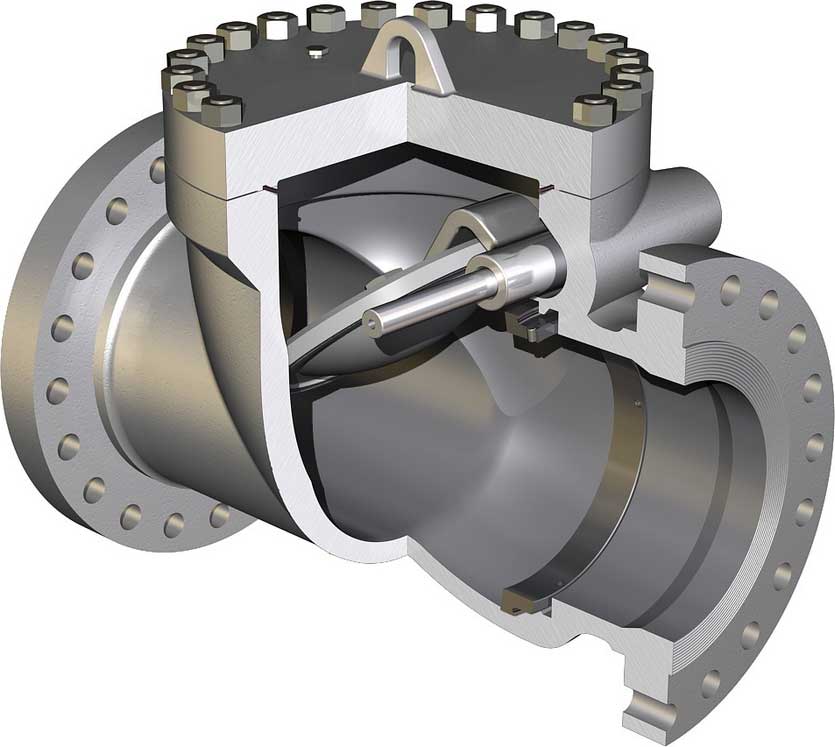
The simplest, and very ancient, valve is simply a freely hinged flap which swings down to obstruct fluid (gas or liquid) flow in one direction, but is pushed up by the flow itself when the flow is moving in the opposite direction. This is called a check valve, as it prevents or “checks” the flow in one direction. Modern control valves may regulate pressure or flow downstream and operate on sophisticated automation systems.
Valves have many uses, including controlling water for irrigation, industrial uses for controlling processes, residential uses such as on/off and pressure control to dish and clothes washers and taps in the home. Valves are also used in the military and transport sectors. In HVAC ductwork and other near-atmospheric air flows, valves are instead called dampers. In compressed air systems, however, valves are used with the most common type being ball valves.
Components
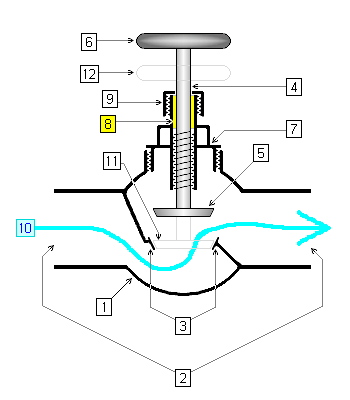
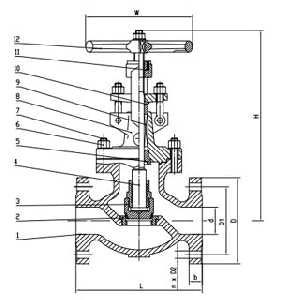
Cross-sectional diagram of an open globe valve. - body
- ports
- seat
- stem
- disc when valve is open
- handle or handwheel when valve is open
- bonnet
- packing
- gland nut
- fluid flow when valve is open
- position of disc if valve were shut
- position of handle or handwheel if valve were shut
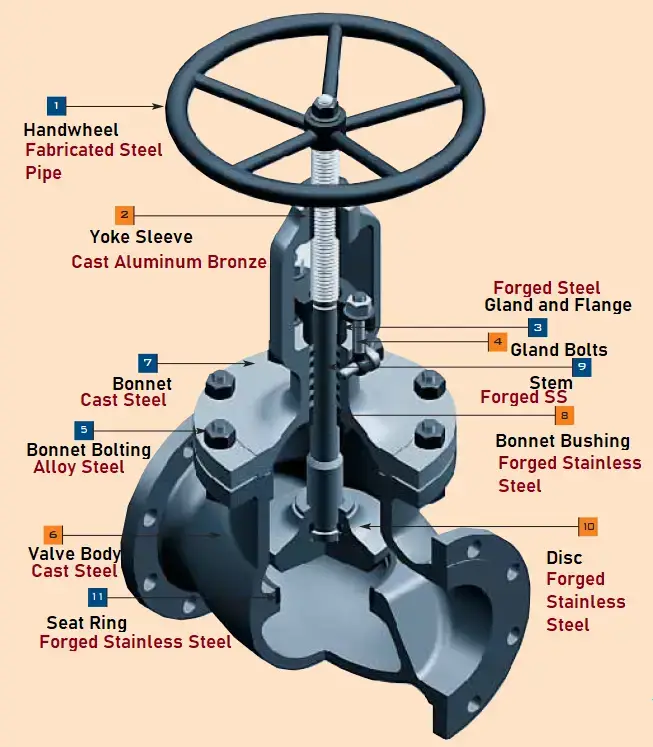
The main parts of the most usual type of valve are the body and the bonnet. These two parts form the casing that holds the fluid going through the valve.
Body
The valve’s body is the outer casing of most or all of the valve that contains the internal parts or trim. The bonnet is the part of the encasing through which the stem (see below) passes and that forms a guide and seal for the stem. The bonnet typically screws into or is bolted to the valve body.
Valve bodies are usually metallic or plastic. Brass, bronze, gunmetal, cast iron, steel, alloy steels and stainless steels are very common. Seawater applications, like desalination plants, often use duplex valves, as well as super duplex valves, due to their corrosion resistant properties, particularly against warm seawater. Alloy 20 valves are typically used in sulphuric acid plants, whilst monel valves are used in hydrofluoric acid (HF Acid) plants. Hastelloy valves are often used in high temperature applications, such as nuclear plants, whilst inconel valves are often used in hydrogen applications. Plastic bodies are used for relatively low pressures and temperatures. PVC, PP, PVDF and glass-reinforced nylon are common plastics used for valve bodies.
Bonnet
A bonnet acts as a cover on the valve body. It is commonly semi-permanently screwed into the valve body or bolted onto it. During manufacture of the valve, the internal parts are put into the body and then the bonnet is attached to hold everything together inside. To access internal parts of a valve, a user would take off the bonnet, usually for maintenance. Many valves do not have bonnets; for example, plug valves usually do not have bonnets. Many ball valves do not have bonnets since the valve body is put together in a different style, such as being screwed together at the middle of the valve body.
Ports
Ports are passages that allow fluid to pass through the valve. Ports are obstructed by the valve member or disc to control flow. Valves most commonly have 2 ports, but may have as many as 20. The valve is almost always connected at its ports to pipes or other components. Connection methods include threadings, compression fittings, glue, cement, flanges, or welding.
Handle or actuator
A handle is used to manually control a valve from outside the valve body. Automatically controlled valves often do not have handles, but some may have a handle (or something similar) anyway to manually override automatic control, such as a stop-check valve. An actuator is a mechanism or device to automatically or remotely control a valve from outside the body. Some valves have neither handle nor actuator because they automatically control themselves from inside; for example, check valves and relief valves may have neither.
Disc

Valve disc A disc or valve member is a movable obstruction inside the stationary body that adjustably restricts flow through the valve. Although traditionally disc-shaped, discs come in various shapes. Depending on the type of valve, a disc can move linearly inside a valve, or rotate on the stem (as in a butterfly valve), or rotate on a hinge or trunnion (as in a check valve). A ball is a round valve member with one or more paths between ports passing through it. By rotating the ball, flow can be directed between different ports. Ball valves use spherical rotors with a cylindrical hole drilled as a fluid passage. Plug valves use cylindrical or conically tapered rotors called plugs.[ambiguous] Other round shapes for rotors are possible as well in rotor valves, as long as the rotor can be turned inside the valve body. However, not all round or spherical discs are rotors; for example, a ball check valve uses the ball to block reverse flow, but is not a rotor because operating the valve does not involve rotation of the ball.
Seat

Ball valve The seat is the interior surface of the body which contacts the disc to form a leak-tight seal. In discs that move linearly or swing on a hinge or trunnion, the disc comes into contact with the seat only when the valve is shut. In disks that rotate, the seat is always in contact with the disk, but the area of contact changes as the disc is turned. The seat always remains stationary relative to the body.
Seats are classified by whether they are cut directly into the body, or if they are made of a different material:
- Hard seats are integral to the valve body. Nearly all hard seated metal valves have a small amount of leakage.
- Soft seats are fitted to the valve body and made of softer materials such as PTFE or various elastomers such as NBR, EPDM, or FKM depending on the maximum operating temperature.
A closed soft seated valve is much less liable to leak when shut while hard seated valves are more durable. Gate, globe, and check valves are usually hard seated while butterfly, ball, plug, and diaphragm valves are usually soft seated.
Stem
The stem transmits motion from the handle or controlling device to the disc. The stem typically passes through the bonnet when present. In some cases, the stem and the disc can be combined in one piece, or the stem and the handle are combined in one piece.
The motion transmitted by the stem may be a linear force, a rotational torque, or some combination of these (Angle valve using torque reactor pin and Hub Assembly). The valve and stem can be threaded such that the stem can be screwed into or out of the valve by turning it in one direction or the other, thus moving the disc back or forth inside the body.
Packing is often used between the stem and the bonnet to maintain a seal. Some valves have no external control and do not need a stem as in most check valves.
Valves whose disc is between the seat and the stem and where the stem moves in a direction into the valve to shut it are normally-seated or front seated. Valves whose seat is between the disc and the stem and where the stem moves in a direction out of the valve to shut it are reverse-seated or back seated. These terms don’t apply to valves with no stem or valves using rotors.
Gaskets
Gaskets are the mechanical seals, or packings, used to prevent the leakage of a gas or fluids from valves.
Valve balls
A valve ball is also used for severe duty, high-pressure, high-tolerance applications. They are typically made of stainless steel, titanium, Stellite, Hastelloy, brass, or nickel. They can also be made of different types of plastic, such as ABS, PVC, PP or PVDF.
Spring

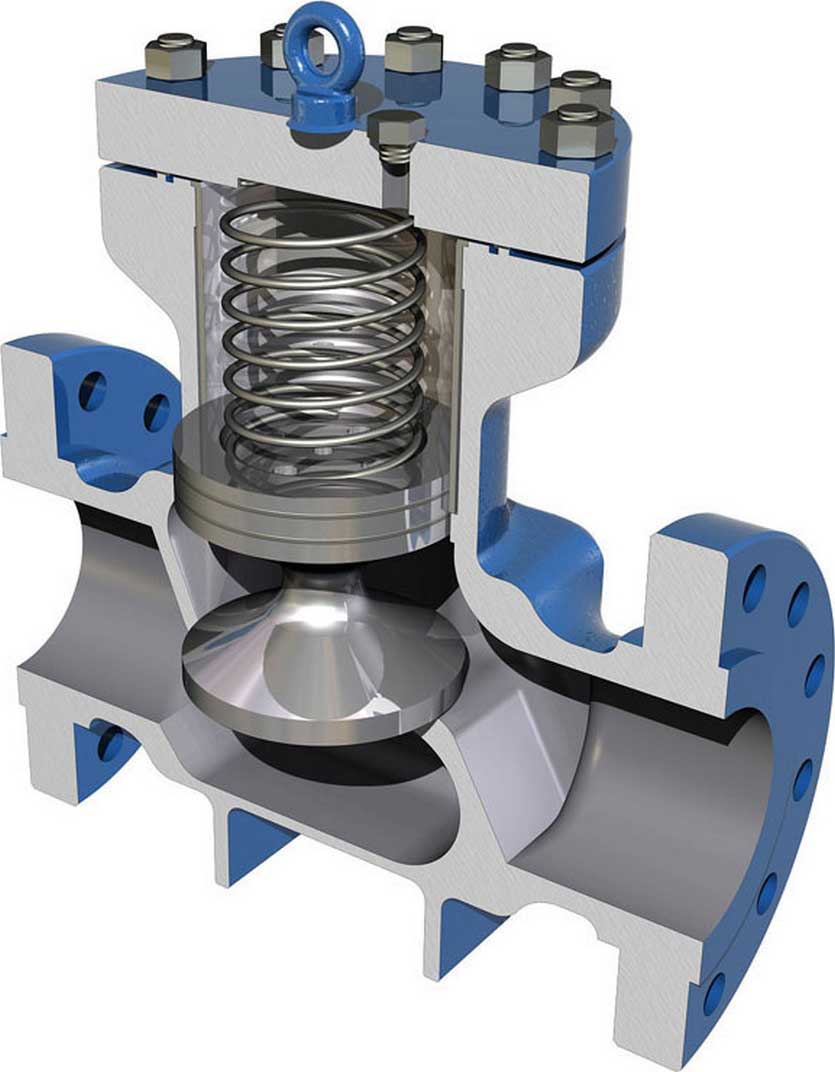
Inconel X750 spring Many valves have a spring for spring-loading, to normally shift the disc into some position by default but allow control to reposition the disc. Relief valves commonly use a spring to keep the valve shut, but allow excessive pressure to force the valve open against the spring-loading. Coil springs are normally used. Typical spring materials include zinc plated steel, stainless steel, and for high temperature applications Inconel X750.
Trim
The internal elements of a valve are collectively referred to as a valve’s trim. According to API Standards 600, “Steel Gate Valve-Flanged and Butt-welding Ends, Bolted Bonnets”, the trim consists of stem, seating surface in the body, gate seating surface, bushing or a deposited weld for the backseat and stem hole guide, and small internal parts that normally contact the service fluid, excluding the pin that is used to make a stem-to-gate connection (this pin shall be made of an austenitic stainless steel material).











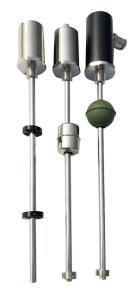
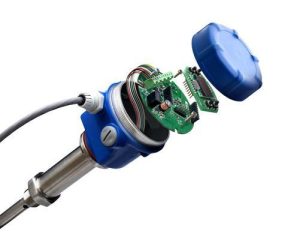 With magnetically actuated float sensors, switching occurs when a permanent magnet sealed inside a float rises or falls to the actuation level. With a mechanically actuated float, switching occurs as a result of the movement of a float against a miniature (micro) switch. For both magnetic and mechanical float level sensors, chemical compatibility, temperature, specific gravity (density), buoyancy, and viscosity affect the selection of the stem and the float. For example, larger floats may be used with liquids with specific gravities as low as 0.5 while still maintaining buoyancy. The choice of float material is also influenced by temperature-induced changes in specific gravity and viscosity – changes that directly affect buoyancy.
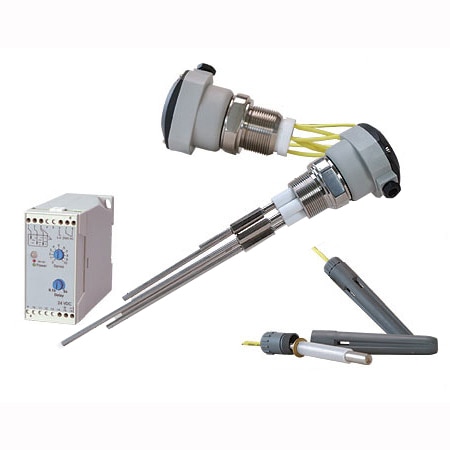 Conductive level sensors are ideal for the point level detection of a wide range of conductive liquids such as water, and is especially well suited for highly corrosive liquids such as caustic soda, hydrochloric acid, nitric acid, ferric chloride, and similar liquids. For those conductive liquids that are corrosive, the sensor’s electrodes need to be constructed from titanium, Hastelloy B or C, or 316 stainless steel and insulated with spacers, separators or holders of ceramic, polyethylene and Teflon-based materials. Depending on their design, multiple electrodes of differing lengths can be used with one holder. Since corrosive liquids become more aggressive as temperature and pressure increase, these extreme conditions need to be considered when specifying these sensors.
 Conductive level sensors use a low-voltage, current-limited power source applied across separate electrodes. The power supply is matched to the conductivity of the liquid, with higher voltage versions designed to operate in less conductive (higher resistance) mediums. The power source frequently incorporates some aspect of control, such as high-low or alternating pump control. A conductive liquid contacting both the longest probe (common) and a shorter probe (return) completes a conductive circuit. Conductive sensors are extremely safe because they use low voltages and currents. Since the current and voltage used is inherently small, for personal safety reasons, the technique is also capable of being made “Intrinsically Safe” to meet international standards for hazardous locations. Conductive probes have the additional benefit of being solid-state devices and are very simple to install and use. In some liquids and applications, maintenance can be an issue. The probe must continue to be conductive. If buildup insulates the probe from the medium, it will stop working properly. A simple inspection of the probe will require an ohmmeter connected across the suspect probe and the ground reference.
































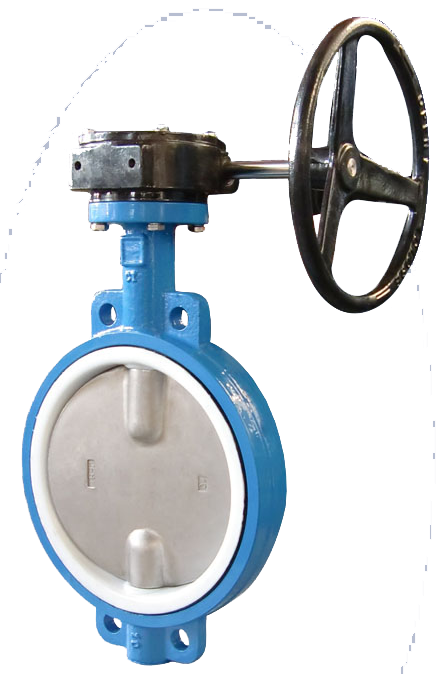


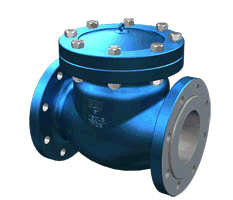
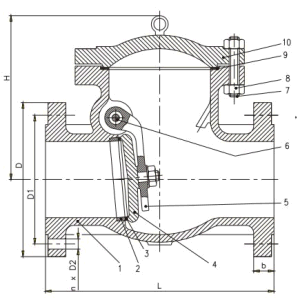 Valve, V Port Ball Valve, Plug Valve