
Principle of operation

Operation is similar to that of a ball valve, which allows for quick shut off. Butterfly valves are generally favored because they cost less than other valve designs, and are lighter weight so they need less support. The disc is positioned in the center of the pipe. A rod passes through the disc to an actuator on the outside of the valve. Rotating the actuator turns the disc either parallel or perpendicular to the flow. Unlike a ball valve, the disc is always present within the flow, so it induces a pressure drop, even when open.

A butterfly valve is from a family of valves called quarter-turn valves. In operation, the valve is fully open or closed when the disc is rotated a quarter turn. The “butterfly” is a metal disc mounted on a rod. When the valve is closed, the disc is turned so that it completely blocks off the passageway. When the valve is fully open, the disc is rotated a quarter turn so that it allows an almost unrestricted passage of the fluid. The valve may also be opened incrementally to throttle flow.  There are different kinds of butterfly valves, each adapted for different pressures and different usage. The high-performance double offset butterfly valve, used in slightly higher-pressure systems, is offset from the centre line of the disc seat and body seal (offset one),

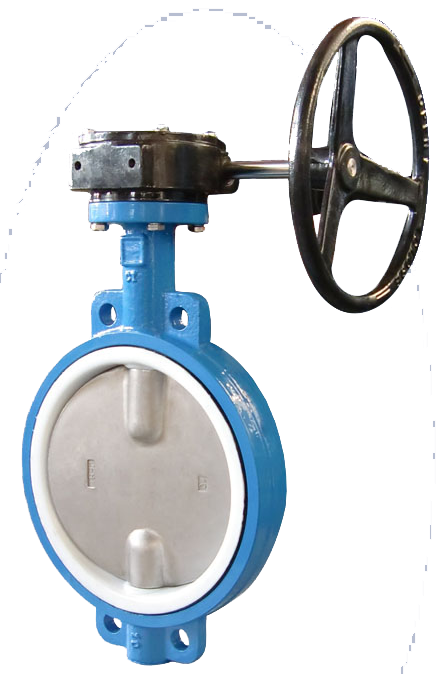
Butterfly Wafer

A butterfly valve with a circular disc in a pipeline, partially closed to regulate fluid flow

The zero-offset butterfly valve, which uses the flexibility of rubber, has the lowest pressure rating.Standar Type Wafer with Seat Rubber :

  • NBR ( Nitril )
  • EPDM,
  • FKM Viton,
  • PTFE,
  • PTFE Lined,

Wafer Compact Body, Etc

The centre-pivoted butterfly valve have small operating torque, convenient operation, labor-saving and smart.It can be installed and maintained at any position.

Choosing the Right Butterfly Valve Type

Butterfly valves are essential in applications where tight shut-off is required. The disc opens and closes with a low-torque rotation of 90 degrees and works for any compatible application. They tend to cost less and are lighter weight, so they are preferred over other types of valves. Butterfly valves are often distinguished by the three main types: zero, double, or triple offset.

High Performance Butterfly Valve ( Double Offset )

A butterfly valve with a circular disc in a pipeline, partially closed to regulate fluid flow

The zero-offset butterfly valve, which uses the flexibility of rubber, has the lowest pressure rating.Standar Type Wafer with Seat Rubber :

  • Metal to Metal Seat and Disc 

Wafer, Flange, Lug Type, This creates a cam action during operation to lift the seat out of the seal resulting in less friction than is created in the zero offset design and decreases its tendency to wear. The valve best suited for high-pressure systems is the triple offset butterfly valve. In this valve the disc seat contact axis is offset, which acts to virtually eliminate sliding contact between disc and seat.

Tripple Offset Butterfly Valve ( Double Offset )

In the case of triple offset valves the seat is made of metal so that it can be machined such as to achieve a bubble tight shut-off when in contact with the disc.

Triply-eccentric butterfly valves (triple-offset butterfly valves) – the seats are either laminated or solid metal seat design.

The double way sealing butterfly valve have float seat, there have O ring between float seat and valve body, it can be used for double side direction of the medium in pipeline.

Triple Offset Butterfly Valve – Benefits, Drawing, vs Other Offsets

Choosing the right type of butterfly valve is key to every application. The available range of butterfly valves from equipment manufacturers includes concentric, single (1x) offset, double (2x) offset, and triple (3x) offset butterfly valves. In this article, you will learn the benefits of a triple offset butterfly valve, see a sample drawing, and realize its benefits vs other types of butterfly valves.

Benefits of a Triple Offset Butterfly Valve

Triple offset, as the name implies, uses three separate offsets to achieve a bubble-tight shut-off. One of the offsets applies to the location of the valve shaft relative to the centerline of the bore. Another offset is between the centerline of the disc/seat sealing surface and the shaft. Then, the third offset is the geometry of the seating surface, which creates a cone shape of the disc and seat. The combination of these three offsets gives this valve its key benefits which are as follows:

  • Geometric Design: The design of the sealing components takes up a right-angle cone shape. Resulting in a cam-action and right-angled design where the sealing components are never in contact until their final degree of closing. Thus, enabling a repeatable sealing and an extended valve life because of its friction-free nature. In addition, the friction-free stroking throughout the valve allows for a relatively lower torque actuator to be used in operating this type of valve. Such a design makes it ideal for automation.
  • Metal-to-Metal Seal: Because of the frictionless sealing mechanism, triple offset butterfly valves use a metal-to-metal seal. This enables a tight shutoff in high-pressure and high-temperature systems. Applications that use friction in sealing often use elastomers or soft material for the valve trim, which may deteriorate with increasing temperature or when the valve is subjected to corrosion. But with the triple offset, corrosion-resistant alloys can serve for both the valve disc and seat, to deliver zero leakage performance.
  • Absence of Cavities: In a triple-offset valve, there are no cavities between sealing components. Therefore, there is no room for debris to clog and disrupt the sealing mechanism, unlike gate and ball valves. This minimizes maintenance costs and extends the valve life.

Rotary valve Discharging Valve

The rotary star type discharging valve has the advantages of simple structure, easy operation, stable operation, low power consumption, low noise and long service life. Rotary valves constitute a derivation of the general butterfly valves and are used mainly in powder processing industries. Instead of being flat, the butterfly is equipped with pockets. When closed, it acts exactly like a butterfly valve and is tight. But when it is in the rotation, the pockets allow dropping a defined amount of solids,  which makes the valve suitable for dosing bulk product by gravity. Such valves are usually of small size (less than 300 mm), pneumatically activated and rotate 180 degrees back and forth.

Default Width dan Height di Tag Marquee Wafer Type Lug Style Type butterffly Flanged Type Butt Welded Ends Types Zero offset Double Offset Triple Offset Both Flanged Ends Wafer Type Ends Lug Type Ends Butt Welded Types Ends ZoeLL neway FMC Toyo FLV Kitz Armaturen Bray concord End Armaturen Cameron Toyo OMB Asahi KVC TOA Gemu OMB Singer Hancock Persta Fisher Crane Emerson Flowserve Shoritsu Zetkama Ayvaz KSB Tomoe Velan Pistek Valve WORCESTER Batusan Ari Faba Ari Armaturen Ebro Coax IMI CCI CCI IMI Samshin Valve Shamsin Valve Samshin Valve.co.kr Dongsan Valve
Klik untuk Hubungi Kami